Author(s): Md. Shah Jalal
Paper Details: Volume 4, Issue 3
Citation: IJLSSS 4(3) 39
Page No: 424 – 442
ABSTRACT
A democratic regime is a procedure of government where political power is practiced by the people via direct or indirect elected representatives. This study aims to discover the core reasons for evolving the democratic structure and clarify main challenges affecting democratic stability in South Asian Countries that includes India, Bangladesh and Pakistan. The study explores the changes of democratic regimes in India, Bangladesh and Pakistan, highlighting on the political conversions and institutional improvements. The research adopts a qualitative, comparative and descriptive-analytical method depends on secondary sources like as academic journals, books, law and policy. The limitation of the study is that it relies only on secondary data sources and highlights only three countries. The findings reveal that India exercise the continuity democratic transformation, Bangladesh show the ephemeral fluctuating democratic practice and Pakistan has experienced regime change that was influenced by military intercession. The study recommends independence of judiciary, electoral fairness, unbiased media, strong institutional activity and fairly political participation for sustainable democracy.
Key words: democracy, regime, political, institutions, sustainable.
INTRODUCTION
Democracy is that institutional arrangement for arriving at political decisions in which individuals acquire the power to decide by means of a competitive struggle for the people’s vote (Schumpeter, 1942).South Asian countries have influenced by many transformations due to the complex political imbalance, colonial history, and biased institutional role, unfair elections, and lack of participation of political parties. In India, democracy has largely endured with regular elections and institutional continuity, although anxiety about majoritarianism and diminishing institutional autonomy have raised (Chandra, 2016; Mehta,2020). At the point of Bangladesh, it has a remarkable democratic change, including military rule, restitution of parliamentary democracy, and recent controversies to electoral integrity and opposition participation (Riaz, 2016; Ali, 2019). In contrast, Pakistan has influenced in regime change by military intervention, weak institutional agency and challenges in sustaining democratic consolidation (Jalal,1995; Talbot,2012).Decolonization took place in 1947 creating two new independent states such as India and Pakistan (Rahman 2021:23).Since then, there was a constructive confusion that these two countries might not properly work on democracy and Democratic movements (Rahman 2021:24). Huntington (1968, p. 19) posited that political participation in developing nations might surpass institutionalization, resulting in instability. People thought that poverty, lack of understanding, and violence between different political, and ethnic groups make the democracy tougher for its succeed as well as impartial role of the institutional actors (Huntington 1968, pp. 20-25). India has had elections since 1952 (Guha 2002:1). It was expected that the pathway would be so easy to nourish democratic march (Guha 2002:1). A number of hurdles and negative actors had been identified which collectively degraded the smooth functioning of democracy. On the other hand, Pakistan, the other part of partition of India (Rahman 2021; 1) had to wait a bit long time to conduct first election. The first general election held in Pakistan in 1954. Practicing smooth transfer of power was not held in Pakistan (Mujahid 1971; 160). It triggered the independence war of Bangladesh in 1971 (Rahman 2021; 25). The military took over the state administration of Pakistan in 1958, 1977, and 1999 (Rijvi 2004; 89). Bangladesh experienced both civilian and military regimes over the first few decades of its existence (Ahamed 2004; 103). Most unfortunately, the march of democratic journey of Bangladesh has been transformed to authoritarian state administration within a few years of Independence. After 1991, it was expected that the will of the citizens would never be violated (Ahamed 2004; 103). The political parties throne into power in 2001 (Ahamed 2004; 103) and 2009, perceived themselves as the owner of state power (The Daily Star; March 15, 2012). The situation turned into a controlled democracy. The citizens lost their fundamental rights, people did not get justice in Bangladesh, all the things were led by the representatives of the government. The concept of parallel government was established by the politicians. In all the meaning of democracy was changed. The Varieties of Democracy (V-Dem) Institute (2023, p. 18) says that liberal democratic indicators are getting worse in South Asian countries, but the condition of India and Bangladesh are the worst. Freedom House (2023) says that people face continuous threat in getting political rights and civil liberties. In this work, it will be tried to understand the failure through the parameters of democracy.
RESEARCH QUESTIONS AND OBJECTIVES
The study aims to identify the nature of changing of democratic regimes in the selected countries, especially in Bangladesh, India, and Pakistan, by examining the collective and original causes to distort of exercising democratic government in these regions. The study explores on how political organizations, electoral process, Executive interference, military dominance, judicial functions, media and political culture assist to the progressive transformation from old democratic system. Besides, the study purposes to examine why democracy in South Asia is gradually being exercised in a misshapen format. Although the selected countries try to exercise the democratic governance, the transformation of practicing democratic format is distorted. The study focuses the different valuable questions: what are the main reasons for distortion of democracy in the selected countries? How have democratic exercises in Bangladesh, India and Pakistan from the ancient region democratic values? What responsibilities do political organizations and state holders play in leaking democratic accountability and transparency? And at last, what roles do judicial bodies follow for durable democratic governance?
DEMOCRATIC REGIME OF SOUTH ASIA AND ITS CONTENTS
The study of democratic regime in South Asia has tremendously transformation due to political heterogeneity, constitutional interruption, and ongoing democratic crises. The research has explored the growth of democracy in India, Bangladesh, and Pakistan since historical, organizational and relative perspectives. Samuel P Huntington, The Third Wave: Democratization in the Late Twentieth Century (1991), expressed that After the ending of British colonial rule, India effectively practiced the parliamentary democracy. On the other hand, Pakistan did not completely exercise the parliamentary democracy due to military inference and authoritarian. In Bangladesh, Parliamentary government had also influenced by military interference and authoritarian.
In the theory of Huntington, “Third Wave of Democratization” (1991) identifies how different South Asian countries accepted the democratic governance after colonialism and authoritarian rule. Huntington contended that democracy is in dangers when institutional and political participations remain comprehensive. Larry Diamond, Developing Democracy (1999), stated that the democracy depends on accountability, political contest, and security of civil freedom, he explained that South Asian democracies mainly depends on elections but lacking of institutional capacity, corruption, and executive supremacy, it suffers a lot .The study also indicates the challenges faced by upgrading countries in protecting corruption, authoritarianism, and political unsteady.
Sunil Khilnani, The idea of India (1997), explored that India is one of the most ancient democracy systems among three countries and he contended that India is the secular nation after division of 1947 despite its huge variety in religion, language, and culture. He identifies that the Indian state became the main force in forming national identity and balance unity. The study also indicates challenges like inequality, communalism, and political unsteady in present time. Rounaq Jahan, Bangladesh politics: problems and issues (2005), examines that the main political challenges of Bangladesh, indicating military interference, weak democratic organizations, corruption, and political clash. She emphasizes that elite power conflicts, authoritarian system, and lack of accountability have handicapped democratic upgrading. The study also highlights the ongoing struggle of the Bangladeshi people for democracy, political steady, and efficacy governance.
Ali Riaz , Bangladesh : A political history since independence (2016),delineated that democratic institutions in Bangladesh often face stress by authoritarian exercise and lack of integrity of opposition party . He also conversed that Bangladesh’s political course indicates a reduction of alternative spaces and the dominance of institutional obligations. The study also emphasizes the country’s economic development and social outcomes despite political challenges. Ayesha Jalal, Democracy and authorizationism in South Asia: A comparative and historical perspective (1995), was focusing on military interruption and constitutional unsteadiness in Pakistan. The military of Pakistan plays influence on political formation, weakening civilian democratic organizations. She specified that colonial administrative contexts influenced unequal democratic results in India and Pakistan. India had nurtured a superior political environment. She has tried to authorize rule of law though in case of minority community that becomes degraded. On the other hand, Pakistan had a hefty military and government presence at first, seldom ensure rule of law.
Ashkari Hasan Rizvi, Military, State and Society in Pakistan (2000), elucidates that military authorities and civilian leadership are always conflicting in democratic country which interferes democratic ongoing situations. The researcher also analyzes how the military settled influence over the society, country, and foreign policy of Pakistan. Amartya Sen, Development as freedom (1999), examines that democracy should be emphasized on securing social justice, freedom and people reasoning with electoral politics. He emphasizes that political rights, healthcare, education, and social facilities are important for developing people abilities and value of life. The study also explores that democracy and freedom play a significant role in reducing poverty and elevating sustainable upgrading.
Aqil Shah in The Army and Democracy: Military Politics in Pakistan (2014) explains that weak civilian organizations, security concerns, and frequent military interferences permitted the military to dominate politics and influence national policies. The study also argues how army control has hindered democratic consolidation and civilian sovereignty in Pakistan. Ayesha Siddiqa, Military Inc: Inside Pakistan’s Military Economy (2007), demonstrates that the military’s economic strength facilitated the acquisition of increased political influence. She emphasizes that military dominance economic actions created unequal power systems and strengthened military controlled over civilian organizations. The researcher also analyzes how this “army economy” impacted on democracy, governance, and accountability in Pakistan.
Steven I Wilkinson, Democratic Consolidation and Failure: Lessons from Bangladesh and Pakistan (2000), compares the democratic experiences of Bangladesh and Pakistan by justifying why democratic procedures succeed or fail. He emphasizes that the significant of institutional steady, civilian dominance, and political collaboration for sustaining democracy. Kanchan Chandra, Why Ethnic Parties Succeed: Patronage and Ethnic Head Counts in India (2004), showed that how ethnic mobilization rooted in patronage does transformed the operative of democracy in India? She delineates that voter often support ethnic parties because they believe access to countries property, jobs, and patronage vie leaders of their own ethnic parties. The researcher also highlights how political competition and electoral procedures encourage the upgrading of identity-based politics in variety societies.
Jennifer Gandhi1 and Ellen Lust-Okar, Elections Under Authoritarianism (2009, pp. 403-422), showed that how did countries with authoritarian propensities use elections to brand their control to legitimate their role. They also examine that elections under authoritarian procedures often useful for rulers manage opposition, achieve legitimacy, and strengthen countries power rather than confirm original democracy. Variety of Democracy Institution (V-Dem 2023, p. 17) perceives a worsening in the autonomy of the judiciary and the press. Emajuddin Ahamed in his great work has shown the gradual process of democratic erosion (2004).The report explains that many states are experiencing democratic reversion via media censorship, political polarization, and diminished civil freedoms.
Ashkari Hasan Rizvi, Pakistan Civil Military Relation in Praetorian state (2004), explains that in Pakistan military intervention, regional factional movements, terrorism activities erode the democratic smooth movement. He indicates that weak civilian supervision, political unsteady, and security concerns permitted the military to supremacy on governance and state policy. A.N.M Arifur Rahman, Cooch Behar merger Agreement: origin of South Asian Discomfit (2021), has shown in his seminal work that the government elected in democratic system becomes authoritarian ignoring common opinion and mandate. He indicates the agreement caused long term statelessness, insecurity, and human misery for enclave dwellers in South Asia. The study also highlights the delayed execution of the 1974 agreement and its effect on regional relations and boundary governance.
There are a good number of works in literature. They have pointed out in specific issues. In this work, it has been tried to understand the causes of democratic erosion, role of the state level actor, politicians and political parties behind such erosion. The future researcher might conduct more researches on relevant other issues. However, most of the articles that have been reviewed here, focus only on segregated issues rather than collective and original distorting cause what is going to be addressed in this research work. The researchers emphasize that there remains a significant research gap in the South Asian democratic regime which is gradually being deviated from the decade old regional practices and has developed a bizarre practice in the name of democracy.
METHODOLOGY
The research adopts a qualitative, comparative and descriptive-analytical method that includes Bangladesh, India and Pakistan to find out the democratic structure and clarify main challenges affecting democratic stability .The study refers to secondary sources such as academic journals, books, law and policy to identify the core reasons of change the selected countries regime. The study analyzed the independence of judiciary, electoral fairness, unbiased media, strong institutional activity and fairly political participation for sustainable democracy to the selected countries. To understand the theories and contexts relevant other books has been followed.
The study only depends on the secondary data, it is the limitation of the study.. Information from primary sources could not be gathered due to limited access to the government and non-government offices relating to political statistics. In this research, some supportive materials were not available. Because it was not possible to collect primary data from different countries due to research budget and time.
DEMOCRACY AND OTHER INSTITUTIONS
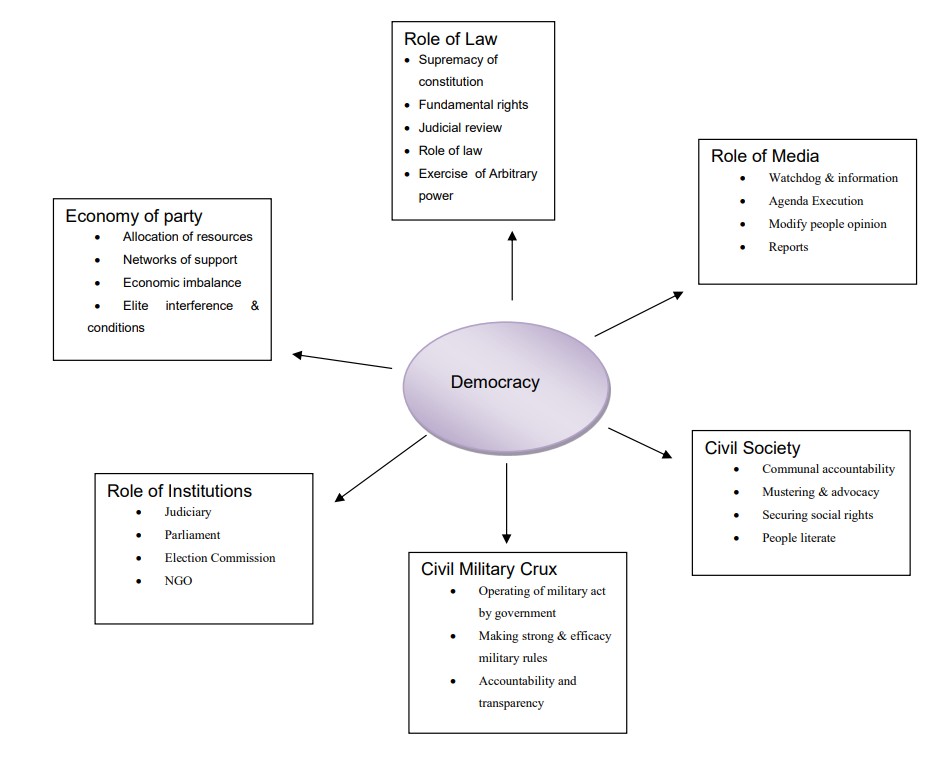
Democracy has strong connections with other organ of the state like legislative, executive, judiciary, media, civil society, and electoral organizations. The efficacy of democratic government totally depends on mentioned organizations activities and accountability. Democracy cannot be effectiveness without support and accountability of these institutions.
Figure 01. Inter connection between Democracies with other institutions
DEMOCRATIC REGIME TRANSFORMATION AND ITS CONTENTS
Robert A. Dahl explained democracy as a systematic way by efficacy participation, electoral integrity, freedom of expression, equal public facilities (Dahl, 1971). Democracy is identified by ensure the role of law, accountability; protect the human rights, fair election and participation of political party. In South Asian countries like as Bangladesh, India and Pakistan are influenced by colonial tradition, constitutional improvement, Political tackles, military interference, and organizational shifting. Democracy is continuity procedural rather than substantive because elections remain to exist while day by day government accountability and freedom of organization weaken (Diamond, 2002; Zakaria, 1997). The study identifies that democracy can’t be examined by constitution or electoral systems. Democracy must be explained by political culture, judicial integrity, military interference, unbiased media and people’s participation. According to opinion of Huntington (1991), democratic amalgamation needs steady organizations and approval of democracy terms by political party. Other valuable measurement of democratic conversion is the transformation from collective democratic engagement forward individual pointer and elite controlled politics. Now a days, Democratic organization has become vulnerable to manipulation and political integrity ( Levitsky & Way, 2010).The study explores that democracy in South Asian countries are shifting into a mixture form where democratic systems synchronize with authoritarian prevailing.
RULE OF LAW AND HORIZONTAL ACCOUNTABILITY
In the question of democracy rule of law is the bible. Everyone must follow the law and equal before law. The rule of law assures that people use their power in a way that is legal (Ahamed 2004;116). O’Donnell (1998, p. 115) argues that democracy entails horizontal accountability, suggesting the presence of independent institutions capable of evaluating executive authority and the role of the political mechanisms. The Pakistani judiciary has archaeologically authorized military coups under the doctrine of necessity, so undermining constitutional supremacy (Newberg 1995, p. 78). Because people appreciated the law, it seemed like the constitution might be broken for political explanations for a small period. The Emergency imposed in India from 1975 to 1977 showed that the Constitution’s defenses weren’t strong enough. The constitutional tools had been used to violate basic rights (Kapur 2010, p. 58) though, the democratic journey was resumed in 1977, the incident proved that the system wasn’t working well. The emergency can be declared on the gave necessity (Uyangoda 2011, p. 101). Some people say that Bangladesh uses the courts for political purposes (Riaz 2016, p. 132). In these three bigger South Asian countries, the struggling democracy usually means that the laws are less rigorous and effective, the weak and minorities are less protected, not that elections would be stopped.
Table 01 Comparative Democracy interference scenery: Bangladesh, India and Pakistan
| Name of Country | Military Government/ Rule of martial | Judiciary announcement illegal Government | Revolution/ Uprising | Notes |
| Bangladesh | 03 Times | 02 Major rulings | 03 Times | Military Endorsed- 1975 to 79, 1982 to 90, & 2007 to 08.Judiciary gave the judgment that 5th and 7th Amendment as unconstitutional.Uprising: 1990 mass uprising against H.M. Arshad’s government and 2024 July uprising against Sheikh Hasina’s Government. |
| India | 0 Time | 01 major judicial interference | 01 Time | No military interferenceAllahabad High Court gave the judgment that the election of Indira Gandi is invalid in 1975.Emergency situation during 1975 to 1977 that was national democracy difficulty. |
| Pakistan | 04 Times | Many times overturning | 02 Times | Military interference under: Ayub khan, Yahya Khan, Zia- ul- Haq, and Pervez Musharraf Judiciary body later argued against military actions.Lawyer Movement 2007. |
Source: Author’s own compilation based on relevant grounds.
Military interference, judicial mobilization, and Uprising have influenced the democratic transformation in South Asian democracy like as Bangladesh, India, and Pakistan. Bangladesh is familiar three times military government by military interference, while the high court later announced the 5th and 7th amendments unconstitutional for legality martial law government. The country again experienced the democratic uprising after the Liberation War 1971 that was the 1990 Mass Uprising (Ahmed, 2015) and July Uprising 2024. Pakistan is familiar to four times military governments under Ayub Khan, Yahya Khan, Zia-ul-Haq, and Pervez Musharraf, and though some military governments were given the validity by judiciary based on the Doctrine of Necessity, later such judgment like Sindh High Court Bar Association case was announced as unconstitutional that was taken by Musharraf ( Talbot, 2012). On the other hand, India has never experienced visible military government by military inference, although the court conduct important constitutional role in 1975 when the Allahabad High Court declared the Indira Gandhi’s election as illegal (Kohli, 2001). Here, India democracy try to stable peoples democracy, Bangladesh, and Pakistan frequently tackled with unsteady of constitution, military interference, and democratic uprisings.
THE ROLE OF THE EXECUTIVE
In the democratic states, the executive branch plays a good role to administer the state. But the way institutions are set up frequently makes the executive branch more centralized.
the political party who remains in power used to manipulate the administrative branch of the state while the bureaucrats also want to be used (Alam & Teicher 2012; 6-7). During the parliamentary election most of the government officer becomes electoral officers creating conflict of interest (Akter 2023;329). In all of the three countries the civil servants are found to show illegal allegiance causing a questionable election. The part who used to throne never go against them as well (Akter 2023; 329-333).
CONSTITUTIONAL FRAMEWORK
In democratic state practice constitution id accepted as the highest authority and safeguard to the citizens. In India, Bangladesh, and Pakistan it has been observed that original constitutionalism is seldom followed by these states. Constitutional obligation for democracy is seen through fundamental freedom, commitment to fundamental rights, adult franchise, religious practice, and mechanisms to ensure the rule of law (Kapur 2010, p. 62). According to Article 8 of Pakistan’s Constitution, the president can fire topple down the parliament (Rizvi 2018, p. 97). In the constitution of Srilanka and Pakistan, president could abolish the parliament and it was set as a check and balance of power (DeVotta 2004, p. 59).In Bangladesh the caretaker government system was introduced but due to opposing by the political parties, it was abolished with the intervention of the court setting a bad precedent in the democratic history of Bangladesh (Riaz 2016, p. 125& Times of India: November 20, 2025). There are some other countries in South Asia who conduct election through federal format of government (Hachhethu 2014, p. 61). The Constitution’s wording alone never can ensure democratic behavior. It needs citizens good will to perceive the solemn expression of the constitution.
MEDIA AND CIVIL SOCIETY
The media and civil society play a vital role for the development of democratic journey (1999, pp. 227. The democratic criticisms and explanation of issues are highly controlled in south Asia which derogates the equal opportunity of expression of the citizens jeopardizing democratic rights (V-Dem 2023, p. 17). The authoritarian practice by the head of the states dictates them to become autocrat (Guriev and Treisman 2022, p. 15). The autocrat governments try to show that without him/her, none would be found to take over the power. The leaders of Awami league used to announce that Bangladesh was only safe at the hand of Sheikh Hasina. The media houses were either controlled or they deliberately circulated such news pointing out that the head of the government was pronouncing credible and legitimate theories (Center for Governance studies, January 17, 2021). Media and civil society play a vital role for free and fair election which enlarge transparency, accountability, and democratic participation (Jalal et al., 2025). Practically those were of point of autocratic governance. Same was dome in India for Noredra Modi (The Hindu; November 17, 2021). In the eye of those political partied none is competent and they were born to resume in state power. Democratic accountability suffers when media freedom goes down and constitutional guarantee of Freedom of expression disappears.
POLITICAL ECONOMY AND CLIENTELISM
Democracies are seen more stable when people possess more money (Przeworski et al. (2000, p. 99). The enduring disparity in South Asia cultivates a political environment which has been marked by patronage culture. The ethnic clientelism hampers the competition based on state policy (Chandra (2004, p. 35). In the subcontinent, especially in Bangladesh, politics has become a profession and money-making process. The political workers are paid for their works. The political processions are arranged at a high price. Whenever money comes up in politics, it becomes target-oriented works in lieu of welfare works. One sort of clientelism develops destroying welfare movement (Robinson and Thierry 2002). During election, the voters expect money from the political candidates (Osborne 2025; 389). The politics subsequently lies on the hand of the businessmen and bureaucrats (Robinson and Thierry 2002).
COURTS AND HORIZONTAL ACCOUNTABILITY
The political governments conspire their opinion through the domestic’s higher courts in the region. The apex courts seldom pronounce the justice with courage. Moreover, the courts legalize the wrong works of the political authoritarian government. It had been observed that a Chief Justice was compelled to leave the country due to pronouncing justice and collision of opinion with the head of the executive and the legislative (Tam 2024; 63). During this time, the courts, election authorities, and anti-corruption agencies can’t stop the executive branch from doing what it wants. O’Donnell (1998, p. 115) pronounced that democracy requires institutional agents capable of preventing abuse. Judicial institutions in South Asia have encountered political pressure or institutional restrictions (O’Donnell 1998, p. 117)). In the past, Pakistan’s courts have permitted the military to utilize its power when it was necessary (Newberg 1995, p. 76). The 2013 impeachment of Sri Lanka’s Chief Justice showed that the executive branch was getting in the way of the judiciary’s independence (Uyangoda, 2011, p. 102). The politicization of judicial appointments in Bangladesh has raised apprehensions over the integrity of institutions (Riaz 2016, p. 132). In India, while judicial independence is legally protected, there has been an escalation of debate around executive supremacy in nominations and selective rejoinders to politically salient matters (Jaffrelot, 2021, p. 49).
ROLE OF THE INSTITUTIONS
The concept of institutionalism is yet to develop in south Asian region. India had more organized mechanisms but during the Modi government the situation has deteriorated. The movement in Kashmir, Asam, Mizoram, Meghalaya and Nagaland has reiterated the failure of Modi government while the authoritarian head of the state became reckless to suppress the voice of the common people, especially the minority communities (Ganguly et al 2024; 7). The courts still work, but they don’t do as good of a job of stopping people from abusing their position. The election commissioners are in charge of the elections, but everyone doesn’t trust them. There are dedicated bodies to curb corruption, but they don’t get employed independently, very often, even they might lose job. Unless institutional format is developed, no democracy would be properly developed (Bermeo, 2016, p. 13).
CIVIL-MILITARY CRUX
The relationships between the military and civilians in South Asian countries are quite different from each other. Pakistan is still a fantastic example of how praetorian politics works. The military thinks of itself as the protector of the country’s ideas (Shah 2014, p. 33). The military involvement in the economy diminishes the necessity for civilian leadership. When India became independent, it made civilian control a very essential part of its government (Wilkinson 2015, p. 40). The discrepancy shows that democracy can collapse even if the military is stronger. The military thinks of itself as the protector of the country’s ideas (Shah 2014, p. 33). Siddiqa (2007, p. 23) points out that in financial incorporation military behave differently. India’s recent fall in democracy happened due to the involvement of military and bureaucrats. Military intervention in state power always defeats the democratic march, one they used to occupy power, seldom leave with a mass uprising (Rijvi 2004; 98). There are two pathways in South Asia that are separate but connected; historically, military backed democratic upheaval in Pakistan, 2ndly, Civilians causing democracy to fail such as India, and Bangladesh.
POLITICAL CULTURE
Debate remains in India indicating citizenship, legislation, and religious identity illustrated the influence of majoritarian narratives on democratic discourse (Jaffrelot 2021, p. 48). India’s elections are fair, but its score for liberal democracy is becoming worse (V-Dem 2023, p. 17). The place of citizen’s independent opinion in engulfed with the religious radicalistic thought and movement. The Bangladesh has elections, although not as many candidates from the opposition usually competes (Riaz 2016, p. 118). Pakistan holds elections that are limited by the orders of powerful unelected groups (Shah 2014, p. 33). The idea of illiberal democracy, which indicates that the Constitution isn’t fair even while the elections are fair enough (Zakaria, 1997, p. 22). The most important thing to remember is that elections don’t tell us how well a democracy works. Liberal protections are just as important. Political Economy and Clientelism Frameworks Economic disparity and partiality render democracy more susceptible. Przeworski et al. (2000, p. 99) show that democracy lasts longer when the economy grows. The main political parties in Bangladesh are at odds with each other, which have led to all and for the power party (Riaz 2016, p. 118). The comparative research suggests that democratic competition in socially dispersed governments may prioritize exclusion rather than inclusion. Elections support the prevailing identity over diversity.
CONCLUSION
The study completes that change of democratic regime in Bangladesh, India and Pakistan have transformed by various historical and political evolutions, as a result different types of democratic constancy and fruitfulness. Despite of exercising of democratic governance in the selected countries, some challenges like as political polarization, corruption, lack of enforcement of rule of law, and institutional weakness continue to obstacle democratic solidification.Among the three counties, India is better steady democratic conditions than Bangladesh and Pakistan where both the countries face more challenging to continue stable democracy.The study recommends that South Asian countries should be emphasized on democratic institution for securing judicial freedom, electoral fairness, accountability, and unbiased media role. The government of these countries should be striated on the ensuring the human rights, freedom of speech and thought to enlarge public trust in democratic governance.Besides, governments should be emerged on exercising democratic culture and creating public awareness on democratic government systems. The military interference must be limited by the civilian supremacy so that military can’t fragile the democratic procedures. Constable democracy depends on constitutional supremacy and governance, political enduring and obey the rule of law.
RECOMMENDATIONS
Democracy needs to be nurtured and properly understood. The ethical values and moral views of every individual contribute to ensure a sustainable democratic discourse. When the Constitution is changed with political meticulous objects and institutions are kept weaker, things become worse. This part of the world is a good example of what’s happening in the rest of the world right now: liberalism is getting weaker, but democracy stays the same. Democratic erosion is visible in all three countries. The level of erosion might not be same and the process of erosion in all three countries is not same also. Whatever is it, it affects human civilization. To overcome the situation, we need to make sure that the courts are fair, that minorities are safe, that institutions are doing well what they are entrusted to, accountable government, extension of moral values, creating trust in political parties, and that the military and civilians work together to make democracy stronger. Without these protections, democracy could turn into a tyranny.
REFERENCES
Ahamed, Imajuddin (2004), The Military and democracy in Asia and the Pacific, R. J. May and VibertoSelochan eds. The Military and Democracy in Bangladesh, Australian National University, pp. 101-118. DOI: http://doi.org/10.22459/MDAP.03.2004
Akter, Nazma (2023), The Crisis of Independence and Impartiality of the Election Commission of Bangladesh: A Study on the Eleventh National Parliamentary Election, International Journal of Research and Innovation in Social Science (IJRISS) ISSN No. 2454-6186 | DOI: 10.47772/IJRISS |Volume VII Issue III, pp. 328-344. https://www.researchgate.net/publication/369794389_The_Crisis_of_Independence_and_Impartiality_of_the_Election_Commission_of_Bangladesh_A_Study_on_the_Eleventh_National_Parliamentary_Election
Alam, Quamrul & Teicher, Julian (2012): The State of Governance in Bangladesh: The Capture of State Institutions, South Asia: Journal of South Asian Studies, DOI:10.1080/00856401.2012.702723
Aqil Shah in The Army and Democracy: Military Politics in Pakistan (2014) . https://sanipanhwar.com/uploads/books/2024-08-28_13-09-28_c888630644f146af655dd999b5c26587.pdf
Bermeo, N. (2016) ‘On Democratic Backsliding’, Journal of Democracy, 27(1), pp. 5–19. https://www.journalofdemocracy.org/articles/on-democratic-backsliding/
Chandra, K. (2016). Democratic dynasties: State, party, and family in contemporary Indian politics. Cambridge University Press. https://assets.cambridge.org/97811071/23441/frontmatter/9781107123441_frontmatter.pdf
Chandra, Kanchan (200r), Why the Ethnic Parties Succeeded,Patronage and Ethnic Head Counts in India, Cambridge University Press, pp. 1-343. DOI: https://doi.org/10.1017/9781108573481.
De, Votta Neil (2004),Blowback; Linguistic Nationalism, Institutional Decay, and Ethnic Conflict in Sri Lanka, Stanford university press, pp. 1- 304. ISBN: 9780804749237.
Diamond, L. (1999) Developing Democracy. Johns Hopkins University Press, pp. 1-230. https://www.press.jhu.edu/books/title/1437/developing-democracy?srsltid=AfmBOor58EYrxDulYitmCFMWzD88X-TdkT-1I9pSb71bsU1PTYZ4OvDY
Freedom House (2023), Report of the Freedom in the World 2023. https://freedomhouse.org/sites/default/files/2023-03/FIW_World_2023_DigtalPDF.pdf
Gnguly, Sumit, Mistree, Dhinsha& Diamond, Larry (2024), The Troubling State of India’s Democracy, University of Mishigan Press, PP. 1-383. DOI:10.1080/00358533.2025.2504598
Guha Ramachandra (2002), Democracy’s Biggest Gamble: India’s First Free Elections in 1952, World Policy Journal, Vol. 19, No. 1 (Spring, 2002), pp. 95-103 [Duke University Press] https://doi.org/10.1215/07402775-2002-2005
Guriev, S. and Treisman, D. (2022) Spin Dictators;The Changing Face of Tyranny in 21st Century, Princeton and Oxford. Princeton University Press, pp 1- 340. https://press.princeton.edu/books/hardcover/9780691211411/spin-dictators?srsltid=AfmBOoo3lscltg_vXa376BFJwDdNiHRKhNEawNyJYuZYI6Az18Y0aYDu
Hachhethu, K. (2014) ‘Party Building in Nepal’, Asian Journal of Comparative Politics, 2(1), pp. 45–66.
https://www.academia.edu/84046829/Party_Building_in_Nepal_Organization_leadership_and_people_A_comparative_study_of_the_Nepali_Congress_and_the_Communist_Party_of_Nepal_Unified_Marxist_Leninist_by_Krishna_Hachhethu_Kathmandu_Mandala
Huntington, S. P. (1991). The third wave: Democratization in the late twentieth century. University of Oklahoma Press. Book.
Jahan, R. (2005). Bangladesh politics: Problems and issues. University Press Limited. Book.
Jalal, A. (1995). Democracy and authoritarianism in South Asia: A comparative and historical perspective. Cambridge University Press.
https://doi.org/10.1017/CBO9780511559372
Jalal, M.S., Rahaman, M., & Das, R. C. (2025). Electoral fairness in South Asian democracy: Exploring the role of media and civil society. International Review of Social and Cultural Studies, 1(3), 109–121. https://doi.org/10.66324/irscs.v1i3.221
Kapur, D. (2010) ‘The Emergency Revisited’, India Review, 9(1), pp. 52–70. Book.
Khan, M. H. (2013). The political settlement, growth and technical progress in Bangladesh (Working Paper No. 2013:01). Danish Institute for International Studies. https://www.diis.dk/files/media/publications/import/extra/the_political_settlement_and_technical_progress_in_bangladesh_final_1.pdf
Khilnani, S. (1997). The idea of India. Farrar, Straus and Giroux. Book.
Kohli, A. (2001). The success of India’s democracy. Cambridge University Press. https://assets.cambridge.org/97805218/01447/sample/9780521801447ws.pdf
Levitsky, S. and Ziblatt, D. (2018) How Democracies Die, Crown Publishing Press, DOI:10.1080/02589346.2020.1769280
Linz, J. and Stephen Alfred (1978),The Breakdown of Democratic Regimes. Johns Hopkins University press. https://www.press.jhu.edu/books/title/8633/breakdown-democratic-regimes?srsltid=AfmBOorLy8dX21FC2M1ZxUaKlWwIbrwWu_gBvtq61Hyf_coIv2T0fbT-
Mehta, P. B. (2020). The burden of democracy. Penguin Random House India. https://www.penguin.co.in/book/the-burden-of-democracy/
Musarrat, R., & Ibrahim, M. (2013). Democratization in India and Pakistan (1999–2012). Journal of Public Administration and Governance, 3(2), 113–129. https://doi.org/10.5296/jpag.v3i2.4001
Newberg, Paula R (1995) Judging the State Courts and Constitutional Politics in Pakistan. Cambridge University Press. DOI:10.2307/2646493
O’Donnell, G. (1998) ‘Horizontal Accountability’, Journal of Democracy, 9(3), pp. 112–126. https://www.democraziapura.it/wp-content/uploads/2015/10/1998-ODonnell.pdf
Osborne, Martin J (2025), Money in Electoral Competition, Models in Political Economy, DOI: 10.11647/obp.0490.12, pp. 373-396.
Papada, Evie and Lindberg,Staffan I. (2023), Variety of Democracy Institute, Department of Political Science University of Gothenburg. https://www.gu.se/en/research/varieties-of-democracy-v-dem
Przeworski Adam, Alvarez Michael E, CheibubAntonioJose, and LimongiFernando (2000) Democracy and Development, Cambridge University Press. Book.
Rahman, A. N. M. Arifur (2021), Cooch Behar merger Agreement: origin of South Asian Discomfit, Journal of Asian and African Social Science and Humanities, Vol. 7, No. 2, PP. 20-33. https://aarcentre.com/ojs3/index.php/jaash/article/view/228/515
Riaz, A. & Rahman, Sajjadur(2016), eds. Routhledge Handbook of Contemporary Bangladesh,Routhledhe publishers. https://doi.org/10.4324/9781315651019
Riaz, A. (2014). A crisis of democracy in Bangladesh. Current History, 113(762), 150–156. https://doi.org/10.1525/curh.2014.113.762.150
Riaz, A. (2016). Bangladesh: A political history since independence. I.B. Tauris. https://doi.org/10.1080/03068374.2017.1269516
Rizvi, H.-A. (2000). Military, state and society in Pakistan. Palgrave Macmillan. https://doi.org/10.1057/9780230599048
Rizvi, Hasan Ashkari. (2018) Military, State and Society in Pakistan, Book Paradise, Pakistan.
Roberto Stefan Foa andYascha Mounk(2016 & 2017) Journal of Democracy on “The Danger of Deconsolidation: The Democratic Disconnect” and “The Signs of Deconsolidation”. https://www.journalofdemocracy.org/subjects/democratic-consolidation/
Robinson, J. A., & Verdier, T. (2013). The political economy of clientelism. The Scandinavian Journal of Economics, 115(2), 260–291. https://doi.org/10.1111/sjoe.12010
Schumpeter, J. A. (1942). Capitalism, socialism and democracy. Harper & Brothers https://eet.pixel-online.org/files/etranslation/original/Schumpeter,%20Capitalism,%20Socialism%20and%20Democracy.pdf
Sen, A. (1999). Development as freedom. Oxford University Press. https://global.oup.com/academic/product/development-as-freedom-9780198297581?lang=en&cc=no
Shah, A. (2014) The Army and Democracy, The Military Politics in Pakistan. Harvard University Press, ISBN 9780674419766. https://www.hup.harvard.edu/books/9780674728936
Shanon O Toole, Tyler Roylance, and Lora Uhlig eds. The Freedom House Report. https://freedomhouse.org/sites/default/files/2025-02/FITW_World_2025_Feb.2025.pdf
Shuriah Niazi (2022), Communal clashes mar Hindu festival in India; https://www.aa.com.tr/en/asia-pacific/communal-clashes-mar-hindu-festival-in-india/2561079
Siddiqa, A. (2007) Military Inc-Inside Pakistan’s Military Economy, Pluto Press, https://www.plutobooks.com/display.asp?K=9780745325453
Talbot, I. (2012). Pakistan: A modern history (Rev. ed.). Hurst & Company. https://cssplatformbytha.com/wp-content/uploads/2025/03/Ian-Talbot-Pakistan_-A-Modern-History-2010-Palgrave-Macmillan.pdf
Tam, Waikeung (2024), Judicial Responses to Politically Sensitive Cases in an Authoritarian Setting: The Case of Hong Kong, Between Governance and the Governed: Navigating China’s Borderlands in a Challenging Era pp. 57-69, https://doi.org/10.4000/12fwc
Uyangoda, J. (2011). Sri Lanka in 2010: Regime consolidation in a post-civil war era. Asian Survey, 51(1), 131–137. https://doi.org/10.1525/as.2011.51.1.131
Wilkinson, S. I. (2000). Democratic consolidation and failure: Lessons from Bangladesh and Pakistan. Democratization, 7(3), 203–226. https://doi.org/10.1080/13510340008403678
Wilkinson, Steven I. (2015) Army and Nation:Wilkinson, S. (2015) Army and Nation, Harvard University Press [ISBN 9780674728806]. https://www.researchgate.net/publication/326293845_Army_and_Nation_The_Military_and_Indian_Democracy_since_Independence_by_Steven_I_Wilkinson_Ranikhet_Permanent_Black_2015
Zakaria, F. (1997), the Rise of Illiberal Democracy, Foreign Affairs, Council on Foreign Relations, 76(6), pp. 22–43. https://www.almendron.com/tribuna/wp-content/uploads/2015/05/the-rise-of-illiberal-democracy.pdf