Author(s): Jyoti Sharma
Paper Details: Volume 3, Issue 6
Citation: IJLSSS 4(1) 01
Page No: 01 – 13
ABSTRACT
Forensic psychology in India is a developing field that serves to bridge psychology and the legal world to address criminal behaviour, accountability, and rehabilitation. This paper discusses contemporary legal perspectives on forensic psychology’s utility in assessing criminal responsibility in actions and assessing mental health and cognitive status in offenders related to behaviour, in the context of pertinent Indian laws and values, such as the Bharatiya Nyaya Sanhita[1] and the Mental Health Care Act. This study includes the utility of forensic psychological methodology, psychological assessments, narco-analysis, polygraphs, brain mapping, etc., employed both in criminal investigations as well as in courts. As a part of this study, the barriers include ethical concerns, judicial apprehension, and the need for new training and standardised protocols. The rehabilitation of offenders through forensic psychological approaches is one area of emphasised importance – identifying and implementing tailored mental health interventions to prevent recidivism and support reintegration into society. A review of case studies, such as the Hathras gang rape and Noida double murder, to demonstrate how forensic psychology can be beneficial in understanding criminal behaviour is discussed. This research is supportive of greater forensic psychology integration prevalence in the criminal justice system in India to increase the validity of outcomes based on legal process, public safety, and align more closely with the values of human rights. The article concludes with a call for collaboration across disciplines, increased public awareness and then policy changes to eventually realise the potential of forensic psychology in the Indian context. The study provides new information that is important for 2025 for linking current laws to changes in forensic psychology, which will improve criminal responsibility assessments and rehabilitation in India.
Keywords: Forensic Psychology, Criminal Behaviour, Legal Responsibilities, India, Mental Health Assessment
INTRODUCTION
Forensic psychology is a developing yet fundamental interdisciplinary field that integrates psychological understanding into the legal system to address multifaceted issues surrounding criminal behaviour, culpability, and the rehabilitation of offenders[2]. In India, the discipline is undergoing extensive growth as the criminal justice system begins to accept scientific and psychological reasoning in the administration of justice. The system has also witnessed acceleration due to the 2023 enactment of the Bharatiya Nyaya Sanhita (BNS), which replaces the 1860 colonial Indian Penal Code and aims to modernise and consolidate criminal law with citizen-focused and evidence-based considerations. Forensic psychologists are an increasingly integral part of this change, assessing offenders’ psychological states, competencies for culpability, assisting in criminal profiling, and providing testimony for the courts.[3]
The Indian justice system has dealt with cyberbullying, online radicalisation, stalking, and crimes related to addiction to the digital world in recent years. These cases require psychological profiling instead of traditional investigations. The fact that the Central Bureau of Investigation (CBI) and the Central Forensic Science Laboratory (CFSL) have behavioural analysis units, which use psychological skillsets to support investigations, demonstrates that psychological expertise is now informing investigators in their understanding of motive, deception, and patterns of risk.[4]
Simultaneously, the issue of mental illness among prisoners has become very serious. Reports from the National Crime Records Bureau (NCRB) state that nearly one in ten prisoners presents symptoms of mental disorders, but few of them have either received counselling or clinical treatment for those illnesses[5]. This indicates a serious shortcoming of India’s rehabilitation processes and highlights the bifurcation between law and psychology in relation to a comprehensive understanding of crime.
By linking forensic psychology to the new judicial model, our legal system can better identify the mental state and intent behind criminal behaviour, thus ensuring just treatment for criminals with relevant psychological impairments and protecting the interests of society. Importantly, forensic psychology applies in general contexts beyond the courtroom. Schneider’s intervention programs, which seek to reduce recidivism rates through addressing underlying psychological disorders, behaviourally modifying behaviours, and re-integrating people from prison back to productive lives in society, rely heavily on forensic psychology. These intervention programs align with a more rehabilitative model of justice now evident in our contemporary society.
Although India has made remarkable strides in the field, forensic psychology faces challenges: there are limited models for established protocols or ethical guidelines, a lack of awareness in the legal community, and a reluctance to admit psychological evidence in the courtroom. Additionally, many new categories of crime, such as cybercrime and digital fraud, will necessitate more nuanced and flexible applications of forensic psychology in practice. This study will examine legal notions of responsibility and rehabilitation through the lens of forensic psychology, with a particular focus on its contributions, issues, and policy implications for the present-day Criminal Justice System in India, arising from the BNS.[6] The research will be valuable in supporting, strengthening, and understanding the use of forensic psychology in the service of effective, evidence-based, and humane pursuit of justice and legal outcomes in 2025.
The Bharatiya Nyaya Sanhita, 2023, legally, under Section 22, has replaced the earlier Section 84 of the Indian Penal Code, but continues to acknowledge that a person with mental unsoundness at the time of an act may not be criminally culpable.[7] However, the continuation of the commonplace McNaughten Rule for criminal insanity does not incorporate contemporary meanings of cognitive or emotional dysfunction.[8] The reform of the law, forensically informed assessment, and evidence-based rehabilitation are more important now than ever.
This thorough introduction sets the stage for contextualising the importance of forensic psychology in the evolving legal framework of India, providing the background for a fuller discussion of the roles of forensic psychology in assessing criminal behaviour, legal responsibility, and rehabilitative systems.
UNDERSTANDING CRIMINAL BEHAVIOUR THROUGH FORENSIC PSYCHOLOGY
Forensic psychology aids in the scientific perspective for understanding criminal behaviour in the Indian legal system[9]. It follows a methodical approach in analysing the various factors, such as motivations, cognitive patterns, emotional triggers, and social influences that drive people to commit crimes, all the while using strong psychological theories and behavioural studies. Forensic psychologists make huge use of investigative methodologies, including criminal profiling, risk assessment, lie detection, and forensic interviewing, all of which significantly contribute to police investigations, court trials, and correctional methods[10]. With these techniques at their disposal, the experts can tell apart normal criminal acts from ones that are the result of mental disorders, substance addiction, or past traumas, thus leading to proper legal evaluations and just court rulings.
In India, the rising cases of cybercrime, organised crime, and juvenile delinquency make the use of forensic psychology in criminal behaviour analysis highly relevant[11]. One of the benefits of psychological profiling is that it enables the police to discover the perpetrators, foresee the direction of criminal activities, and know the individual and societal risk factors that lead to criminal activities. Forensic psychologists are increasingly involved in developing the rehab programs where they design the interventions suited to address the patients’ psychological issues and cut down the chances of recidivism[12]. This strategy is in line with the new methods laid down in the Bharatiya Nyaya Sanhita (BNS) that give utmost importance to rehabilitative justice and scientifically supported assessment during legal proceedings.
Forensic psychology taps the psychological assessments of the accused into the legal system, which leads to effective crime prevention measures, more objective criminal responsibility determinations, and improved situations for both victims and offenders. The joint activities of a psychologist, an investigator, a lawyer, and a correctional professional are essential for turning psychological insights into practical legal solutions. Some of the latest advancements, like digital profiling, AI-based behaviour evaluation, and trauma-sensitive forensic practice, are indications of the dynamic growth and modern application of forensic psychology in India for comprehending and controlling criminal behaviour even in the present day.
The rising trends like crimes done through the internet, hate speech, and online radicalisation have come to a point where psychological profiling is needed to get a grasp of the offenders’ motives and patterns. To illustrate, the Central Forensic Science Laboratory (CFSL) and the National Institute of Criminology and Forensic Science (NICFS) have started employing psychologists in criminal cases, including lie detection, behavioural analysis, and victim profiling.
LEGAL PERSPECTIVES: RESPONSIBILITIES AND MENS REA
Mens rea, which translates to “guilty mind” in Latin, originates as a principal notion in the field of law that deals with the mental status or intention of the individual at the instant of the offence. In India, mens rea is regarded as an indispensable part of criminal liability whereby the defendant is required to have had a culpable mental state, such as intention, knowledge, recklessness, or criminal negligence, alongside the physical act (actus reus) to be found guilty. The Bharatiya Nyaya Sanhita (BNS), which was enacted in place of the Indian Penal Code (IPC), is the embodiment of this concept, indicating that the law should not only concern itself with the person’s actions but also with his state of mind when he was committing the act, thus facilitating the proper dispensing of justice[13].
Indian courts have reliably maintained that mens rea is a requirement unless the statutory wording makes it clear that it can be ignored[14]. For example, in Ravule Hariprasada Rao v State (1951), the Supreme Court of India stated that criminal guilt will not be established without proving a guilty mind, unless that statute expressly relieves a guilty mind[15]. The BNS provides a list of numerous offences that require mens rea to apply, such as culpable homicide (Section 100), murder (Section 101), and criminal conspiracy (Section 61)[16]. Each case required some form of intention or knowledge before establishing responsibility. Alternatively, several offences within BNS have moved away from requiring mens rea, particularly those broad public welfare offences. In those cases, omitting mens rea makes some sense for efficiency purposes or for the social good.
Forensic psychology’s involvement in legal responsibility intersects with mens rea, due primarily to the role of expert evaluations about the accused’s mental state and capacity to form an intention. Psychological evaluations of an accused provide courts with important information to differentiate between intentional acts and acts conducted due to mental illness and/or diminished capacity, assisting the mens rea inquiry. Further, forensic psychologists assist in considering multi-faceted psychological aspects such as recklessness or negligence impacting levels of criminal intent, ultimately refining how legal definitions of responsibility are analysed from a BNS perspective[17].
In Surendra Mishra v State of Jharkhand (2011), the Supreme Court emphasised that the insanity defence in all cases must be factually determined[18]. An objective ‘insanity’ medical diagnosis cannot be used to automatically release the accused from liability. The Court further held in Hari Singh Gond v State of Madhya Pradesh (2008) that the defence has the burden of demonstrating the criminal law standard of legal insanity, under Section 105 of the Indian Evidence Act, 1872[19]. These decisions emphasise that law will maintain its priority concern in proving incapacity as a demonstrative aspect of the offender rather than the larger concept of psychological incapacity.
In the Indian context, we need to bring forensic psychological evaluations into the justice system. The use of expert evidence by forensic psychologists and psychiatrists should become standard and required in trials involving claims about mental health. Pre-trial assessments and post-conviction rehabilitation plans will allow courts to shift from punishment to a standing and justification that can be supported by evidence and practice.[20]
Understanding that mental illness has the potential to impact perception, impulse control, and judgment does not mean that one excuses crime, but rather provides justice through understanding. Therefore, law and psychology must unite to ensure that responsibility is assigned not only for what the individual did, but for their state of mind when they acted.
REHABILITATION OVER RETRIBUTION: A PSYCHOLOGICAL APPROACH
Criminal law in India has traditionally had a ‘reformative’ orientation, as entrenched in Article 21 of the Constitution of India, which guarantees the right to life with dignity. Forensic psychologists have a significant role in developing rehabilitation programs for offenders, especially for juveniles and people with mental disorders. The National Institute of Mental Health and Neurosciences (NIMHANS), among other institutions, are currently experimenting with the process of changing an offender’s behaviour with therapy for behaviour modification, anger management, and restorative therapy, which many prison settings, including Tihar Jail’s psychological counselling cells, incorporate.
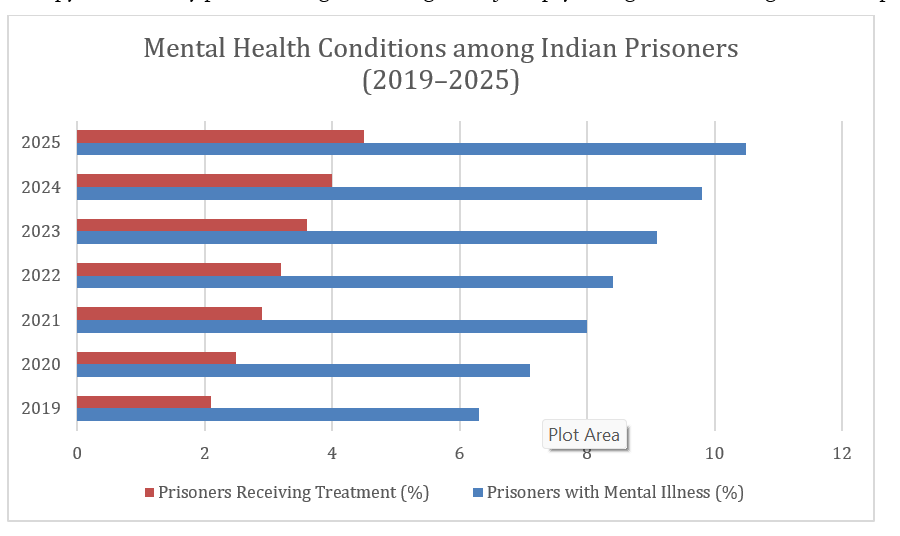
Source: National Crime Records Bureau (NCRB), Prison Statistics India (2019–2025), Ministry of Home Affairs, Government of India.
The statistics suggest a continuing upward trend in the proportion of prisoners experiencing mental illness from 2019-2025. While there has been a moderate increase in awareness and screening for possible mental illness, the gap between diagnosis and treatment is still significant. It is expected that in 2025, fewer than half of mentally ill prisoners will receive appropriate clinical or psychological care, exposing the need for institutional reforms and for policies that orient towards rehabilitation.
MENTAL ILLNESS AMONG PRISONERS (2019-2023)
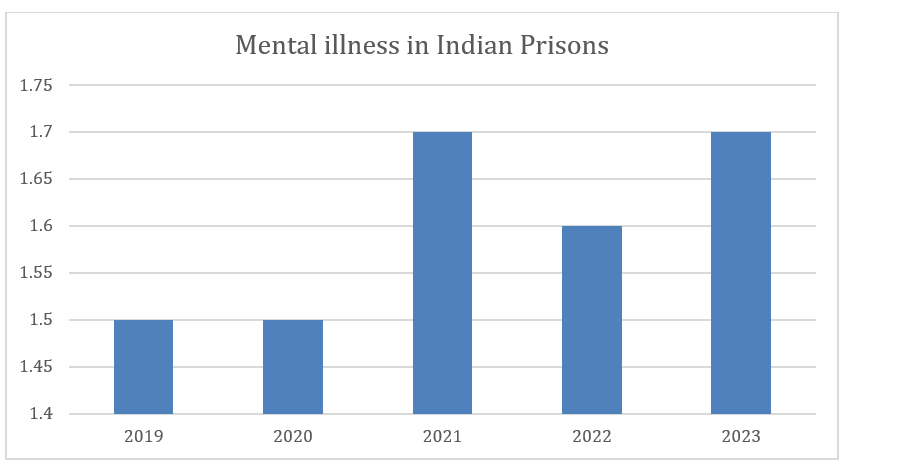
Source: National Crime Records Bureau, Prison Statistics India (2019-2023), Ministry of Home Affairs, Government of India
This bar graph demonstrates the proportion of mentally ill prisoners in India from 2019 to 2023, according to the official statistics provided by the National Crime Records Bureau (NCRB). Even though the total number of prisoners fluctuated during the mentioned period, the percentage of inmates with mental disorders has stayed remarkably stable between 1.5% and 1.7%. The data emphasise the difficulty that the authorities have been confronting in dealing with the mental health issue in prisons, and the need for better psychological screening, treatment, and legal protections in prisons has become more urgent.
COMPARATIVE LEGAL STANDARDS FOR CRIMINAL RESPONSIBILITIES: INDIA, UK, USA, AND CANADA
| Jurisdiction | Key Legal Test | Example Case | Modern Approach |
| India | Section 22 BNS, 2023 (McNaughten-based test) | Surendra Mishra v. State of Jharkhand (2011)[21] | Nothing major has improved yet; Cognitive test |
| UK | McNaughten Rules | R v Windle (1952)[22] | The Law Commission is making ongoing recommendations for reforms. |
| USA | Model Penal Code Test (Substantial Capacity Test) | US v. Freeman (1966)[23] | Recognises Cognitive + Volitional Impairment |
| Canada | NCRMD Test (Not Criminally Responsible) | R v. Swain (1991)[24] | Rehabilitation-driven framework with Review Boards |
CONTEMPORARY CHALLENGES AND EMERGING DIRECTIONS
The criminal justice system of India is undergoing substantial transformations in terms of technology and society at the same time, and this has made the work of forensic psychology more complicated. These changes have made it necessary to have new strategies for evaluation, to have legal procedures that are more in line with current times, and to have robust ethical protections[25]. The most pronounced difficulties of the next decade are indicated by the following new fields.
DIGITAL BEHAVIOURAL CRIME
The transformation of criminal behaviour has been brought about by the growing number of AI-assisted crimes, such as forgery, cyberstalking, revenge pornography, financial scams, and deepfake use. New criminals very frequently work anonymously and employ sophisticated methods to control, trick, and mentally harm the victim using the internet and other digital means. Forensic psychology is now required to investigate the digital realm, analysing online grooming, cyberbullying, compulsive use of the internet, and impulsivity in the digital world as the new human and moral patterns[26]. Models of profiling grounded in the patterns of physical crime scenes are inadequate. The digital crime scene must be studied by the behavioural experts through the digital traces left behind, the communication styles on the internet, the patterns of the metadata behaviour, and the psychological triggers of the cybercrime. This changeover also necessitates the training of the investigators and psychologists in terms of technological literacy, which will enable them to comprehend how the digital environment fosters aggression, anonymity, and deviant behaviour.
JUVENILE DELINQUENCY AND PEER INFLUENCE
India has witnessed a steep rise in young people engaging in cybercrimes, group violence, drugs, and other such illegal activities[27]. Adolescent peer pressure, social media influences, and adolescent identity crisis are the major causes of these acts. Forensic psychology points out that responses with penalties, like imprisonment, usually aggravate the problem of behaviour. On the other hand, approaches like community involvement, counselling, family therapy, school-based behaviour programs, and positive peer influence models are more effective in preventing long-term criminality. The Juvenile Justice Act seeks to provide a balance between accountability and reform, but inconsistent implementation means that a lot of juveniles do not get the required psychological assessments[28]. In the digital era, the rehabilitation of young offenders involves knowing their online environments, social relationships and emotional needs.
FORENSIC MENTAL HEALTH LEGISLATION
The Mental Healthcare Act, 2017, has given solid protections to mentally ill people, even those who are imprisoned, but it is still not very well integrated with criminal law[29]. Judges frequently find it hard to relate mental health rights to the actual forensic assessments, and this leads to not treating or evaluating the offenders early enough. Mental health professionals, forensic psychologists, or organised treatment plans are still not available in many prisons. It is necessary to have new legal enactments that:
- At every point in the legal procedure, mental health screening is required.
- Forensic psychologists are included in the investigation teams.
- They guarantee that psychological progress is relevant for rehabilitation.
- It connects the provisions of BNS with mental health evaluations for the purpose of deciding culpability.
To reinforce the results, the rules should be formed regarding the court-ordered evaluations, insanity defence assessments, and post-conviction rehabilitation under the BNS system.
PSYCHOLOGICAL EVALUATION IN SENTENCING AND PAROLE DECISIONS
In many countries, courts typically, and in some instances routinely, rely on offender profiling, risk assessments, and psychological assessments before sentencing, bail, or parole decisions[30]. In India, this is still uncommon. Typically, Judges look only at legal facts and do not receive information on:
- The offender’s mental state at the time of the offence
- The risk of the offender re-offending
- The offender’s suitability for rehabilitation[31]
- The psychological triggers for the behaviour
Assuming psychological assessments are used routinely, injury caused by offenders can be managed to reduce reoffending and ensure that, when sentences are delivered, less focus is placed on the correctional component of an offender’s sentence.
The use of risk assessment tools, personality inventories, and behaviour assessments to distinguish between offenders who require counselling and therapy versus those who require rehabilitation before re-entering society.
AI, PREDICTIVE POLICING, AND ETHICAL CONCERNS
If guided by behavioural science, predictive policing tools may identify early warning signs of criminal activity; these tools evaluate patterns, prior behaviour, and social indicators to identify individuals or scenarios that may be at very high risk of offending behaviour. However, these technologies also raise some ethical dilemmas:
- Misuse of personal data
- Algorithmic bias against certain groups
- Invasion of privacy[32]
- Labelling individuals based on predictions rather than on actual behaviour
Forensic psychology must therefore provide ethical guidance to technology. A human understanding of behaviour is crucial in preventing algorithms from becoming destructive, discriminatory, or simply too invasive in people’s lives[33]. AI must support justice systems, not supersede human decision-making or violate rights in the process.
CASE LAW
SUKDEB SAHA V. STATE OF ANDHRA PRADESH (SUPREME COURT, JULY 2025)[34]
The Supreme Court stated that “mental health is an integral part of the Right to Life under Article 21.” The Court held that neglecting mental health is a violation of human rights and that the State, schools, and coaching institutions are all responsible to protect the psychological well-being of the citizen. This judgment treats psychological factors as mandatory consideration in criminal law and the broader legal system, especially when analysing criminal responsibility or rehabilitation needs.
V.I. Thankappan v. State of Kerala (Kerala High Court, 2024):
Court clarifies that severe dementia (including Alzheimer’s) falls under “intellectual disability” as per the Indian Citizen Security Code (Bharatiya Nagarik Suraksha Sanhita). It affirms that the trial of persons accused of crimes with severe cognitive impairment will be fair only if their mental status is adequately evaluated. This ruling has accepted the necessity of modern psychological assessment in the context of criminal responsibility, thus aligning Indian law with international standards.
CONCLUSION
The changing relationship of forensic psychology and criminal law represents a clear movement away from a punishment-centred focus to understanding the deeper psychological, social, and behavioural factors underlying crime. In India, the growing emphasis on mental health on criminal behaviour has encouraged courts, investigators, and policymakers to rethink conventional approaches to culpability. This is strengthened by the Bharatiya Nyaya Sanhita, court-led prison reforms, and a greater national discussion and emphasis on psychological health. As additional institutions come to understand the complexities surrounding criminal behaviour, the justice system is more equipped to reach decisions that are evidence-based, fair, and humane.
The future of our criminal justice system rests on the incorporation of forensic psychological services into legal and correctional systems. Extensive evaluations of mental health, expert opinions, offender profiles, and rehabilitative messaging will greatly enhance the accuracy of decisions involving criminal responsibility. Additionally, consistent investment in prison counselling, collaborative treatment models, and trauma-informed systems will reduce recidivism and promote long-term integration into society. Improving collaboration between psychologists, psychiatrists, lawyers, and enforcement will help ensure justice is achieved and understood.
In the end, forensic psychology is not simply an ancillary discipline; rather, it is a paradigm shift that can change how Indian society thinks about crime and punishment. When we regard criminal conduct as a reflection of psychological and social influences, as opposed to a mere violation of criminal law, the system can deal with the causes of offending behaviours. This time, for a justice paradigm that values accountability while recognising the human capacity for personal change. As India progresses, the ongoing development of forensic psychology will provide an especially important means to build a justice system that reflects a balance of one, the protection of society, and two, rehabilitation, compassion, science, and empathy.
[1] Bharatiya Nyaya Sanhita (2023).
[2] S Nath, ‘Forensic Psychology and Its Legal Relevance in India’ (2023) 18 Indian Journal of Forensic Sciences 122
[3] S Kaur, ‘Mental Health and Criminal Responsibility: A Legal Perspective’ (2025) 20 Law and Psychology Review 37
[4] Central Bureau of Investigation, Behavioural Analysis Unit Annual Review (2024)
[5] National Crime Records Bureau, Prison Statistics India 2024 (Ministry of Home Affairs 2024)
[6] P Singh, ‘BNS and its Implications for Criminal Justice Reform’ (2024) 11 Indian Law Journal 150.
[7] Bharatiya Nyaya Sanhita 2023, s 367.
[8] Surendra Mishra v State of Jharkhand (2011) 11 SCC 495.
[9] V Sharma, ‘Understanding Criminal Behaviour: Forensic Psychology Perspectives’ (2024) 12 Indian Journal of Forensic Sciences 34
[10] S Nath, ‘Psychological Assessment and Criminal Profiling in Indian Law’ (2023) 18 Law and Psychology Review 157
[11] R Gupta, ‘Cybercrime Trends and Psychological Profiling’ (2025) 7 Cyber Law Review 45
[12] P Singh, ‘Collaborative Crime Investigation: Integrating Psychological Insights’ (2024) 15 Indian Law Journal 112
[13] Bharatiya Nyaya Sanhita 2023.
[14] Ibid
[15] Ravule Hariprasada Rao v State AIR 1951 SC 234
[16] Bharatiya Nyaya Sanhita, Sections 100, 101, 61
[17] V Sharma, ‘Psychological Assessments and Mens Rea’ (2025) 20 Law and Psychology Review 45
[18] Surendra Mishra v State of Jharkhand (2011) 11 SCC 495
[19] Hari Singh Gond v State of Madhya Pradesh (2008) 16 SCC 109
[20] Law Commission of India, Report on the Insanity Defence and Criminal Responsibility (Report No 279, 2024)
[21] Surendra Mishra v. State of Jharkhand, (2011) 11 SCC 495
[22] R v Windle (1952) 2 QB 82
[23] United States v. Freeman, 357 F.2d 606 (2d Cir. 1966)
[24] R v Swain (1991) 1 SCR 933 (Supreme Court of Canada)
[25] David Canter, Forensic Psychology (Routledge 2022) 56
[26] K Jaishankar, ‘Cyber Psychology and Digital Criminology’ (2023) 14 Journal of Cyber Studies 22
[27] National Crime Records Bureau, Crime in India 2023 (NCRB 2024)
[28] Juvenile Justice (Care and Protection of Children) Act 2015
[29] Mental Healthcare Act 2017
[30] American Psychological Association, Guidelines for Forensic Risk Assessment (APA 2022)
[31] S Vasantha Kumari, ‘Forensic Psychiatry in Sentencing Decisions’ (2023) 8 Indian Journal of Forensic Medicine 41
[32] Brent Mittelstadt, ‘Ethics of Predictive Algorithms in Criminal Justice’ (2018) 26 AI & Society 37
[33] Indian Council of Social Science Research, AI Behavioural Ethics Framework for Law Enforcement (ICSSR 2024)
[34] Sukdeb Saha v State of Andhra Pradesh INSC 893 (SC)